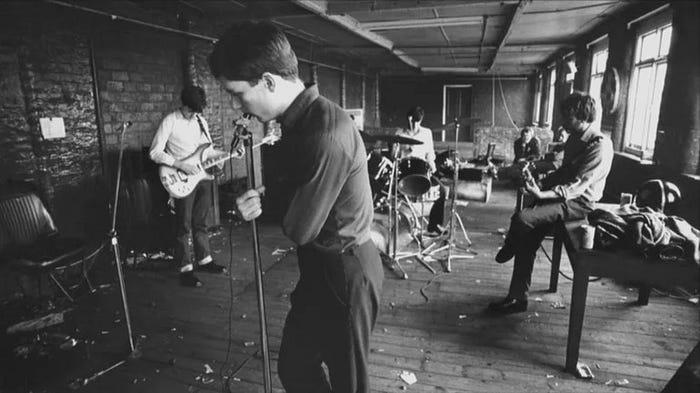
Probably one of the most influential music acts in the 20th century, Joy Division has inspired everyone from Brandon Flowers of The Killers, to hip-hop artist Danny Brown, to Bloc Party and countless other bands since their formation back in 1976. In that span of time between then and now, their sound has been mimicked, sampled, remixed, and paid homage to more times than can be counted. Between the biting lyrics of Ian Curtis, the droning basslines of Peter Hook, the commanding guitar riffs of Bernard Sumner, and the catchy drumline of Stephen Morris, there exists a sound so unique, it has never been accurately replicated, yet it exists prevalently in the alternative scene today. And although their sound is not well-known for its polish, (likely because it doesn’t have any) there is still a distinct difference between what was recorded in the studio and what was performed by them live on stage. By modern 21st century standards, the production quality of their live stuff is, frankly, terrible. Even for the standards of the time these songs were recorded, it’s terrible. But in these recordings, in this gritty, brutal, emotional space, we can see the heart of this band. If you listen to their live performances, you begin to understand what this band really represents. You begin to understand what makes their sound so unique, what obstacles they had to overcome as performers, and what it really means to have a band with such a prolific sound. It is this reason, and many others, why I think true Joy Division fans are so enamored by the band’s live performances.
Birmingham University
It is May 2nd, 1980, and Joy Division is performing at Birmingham University. Though there’s a few debates about what the last live performance from this band was, given the timeline, and the inevitable tragedy that would ensue in just a few weeks after this performance, this is arguably the last live performance ever made by Joy Division as a band, for it would be Ian Curtis’s last live performance forever. On paper, it was the beginning of an enterprising band that was gearing up to travel across the Atlantic and begin touring in the US. Their albums and live recordings could all be simply summed up as demos and early works to big name record companies who saw a serious potential in the band. Yet, the reality of their situation was far more tragic, marking the moments before the inevitable dissolution of Joy Division. In the midst of this tragedy, the anxiety and the excitement, the pain and the suffering, there is an artistic magic that is unmistakable. It flourishes in Birmingham University. There are several factors that come together to make this particular live performance so special. In my opinion, it is the most important live performance of their career, for it showcases the true sentiment behind Joy Division — all of its flaws and all of its victories as a band.
Personal Growth and The DIY Spirit
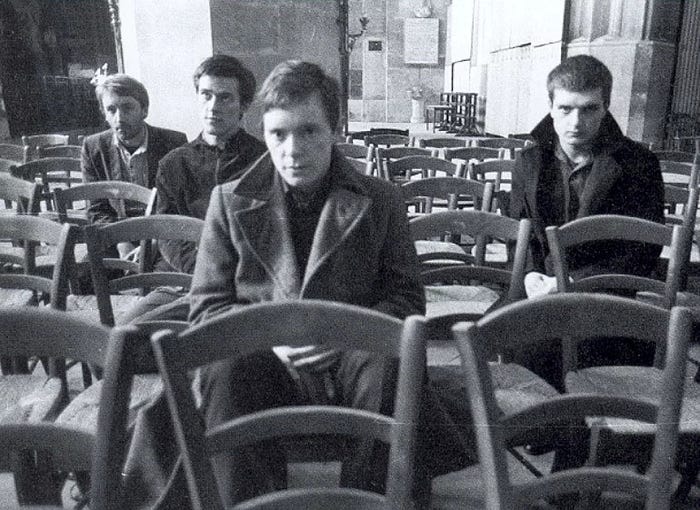
In an interview with Reverb, Peter Hook once explained the origin of his incredibly unique sounding bass riffs. When the band was first formed, Hook played his bass well. He was — and still is — an insanely talented bassist. But he had one Achilles’ Heel, and it was his fifteen-dollar amplifier, which as he described it, “sounded like fifteen dollars.” When he played low bass notes, as is customary for bass players to do, it created a distorted, garbled sound. “You couldn’t hear any tone at all,” he claimed. Because of this, he had to compromise. He had to create his interesting and complex basslines, but he had to do it in the upper register of the bass, playing predominantly on the last two strings of his guitar somewhere in the middle of the neck. What formed from this struggle were the droning, attention-grabbing, rhythmic bass riffs we know and love today. Ian Curtis, himself, said he adored the droning from Hook’s bass. The fact that Hook dabbled not only in single notes, but in chords as well, was a particular favorite for Curtis. He encouraged Hook to continue to play in that style.
Peter’s struggle with his equipment wasn’t the only challenge amongst the band’s members, and it wasn’t the only one that formed the unique and powerful sound that defined them as a band. In addition to Hook adapting to his mediocre equipment to create fantastic and iconically powerful melodies, Bernard Sumner, the guitarist/keyboardist of the band had to learn a few lessons in stage management. Often wanting to shy away from the spotlight, so much so that he was very reluctant to become New Order’s frontman in the wake of Ian Curtis’s passing and the dismantling of Joy Division, Bernard wanted to share his art and nothing more. The nature of his role, however, required him to be in the spotlight. His crisp, glaring guitar solos ran through a beautiful Vox amp, and the lackluster mixing in Birmingham University brought his guitar to the forefront just as quickly as it washed it out behind the rest of the band members. This was a common phenomena for the band, with most of their live recordings having frequent hiccups like these. Bernard, no doubt, had to stay confident and keep his cool throughout the entire set. Stephen Morris was on drums just trying to keep everyone together and in rhythm, a job which is, itself, an insanely hard thing to do, especially in the dawn of the post-punk scene, notorious for complex and abstract drumlines and rhythm sections. Then, of course, there was Ian Curtis, who wasn’t without some technical difficulties of his own. His voice would teeter in and out, riding between being drowned out in the background of his own song, and then suddenly shouting his angst and frustrations directly into your ears. Yet if this was a mistake in the production quality, I don’t want to know how the cleaner version would sound. The dichotomy and suddenness of this wild oscillation creates so much tension and energy for the listener that it’s downright invigorating. But beyond this, Ian also had the greatest struggle of all of them. He struggled in his mental illnesses, and he struggled with his epilepsy, and he struggled with the tender nature of his lyrical content. Pushing himself to the limits of his physical and mental ailments, he produced his lyrics with the utmost unique vigor and grit, the kind that is real and rare.
In the challenges against themselves, and against the environment they found themselves in, they not only adapted, they created a sound that not only impressed fans of the day, but revolutionized music forever, creating lovers of their music across multiple cultures, and multiple generations. These four, not-so-well-off boys from Northern England created something powerful and significant, and they did it through adaption, determination, and a love of the creative process. I call this the DIY spirit. It isn’t often that you see artists come together with no real musical training, and no corporate interest groups to sponsor them, climb out of the muck, and produce something truly beautiful. Joy Division is a collection of those such artists.
You Can Polish a Piece of…

One of the most prevalent aspects of music in the modern age is how crisp of a sound we can not only produce, but transmit through speakers and headphones. Through digital production, we can produce some of the cleanest, sharpest, and purest tones, and it is truly a beautiful thing. A sixteen-year-old, with the right software, can make her dreams come true, and in her own basement, can create music that required an entire studio not fifty years ago. Yet with all of this power, and all of these advanced tools, we begin to see the creative process backfire. We become slaves to the mighty tools we’ve created. Now, the polish is the only thing that matters. The catchy beat, the same four chords on an electronic keyboard, the meaningless lyrical content, it all amounts to nothing because today’s music industry only cares about one thing — polish.
Those who truly appreciate music can see this trend in full-swing. It’s been this way for two decades now, after all. So, some of them look to musicians of the past to find something that feels real. I think one of the appeals that young people have to Joy Division today is that the sound produced is nothing like what they’re used to. It’s rare to find a rock band these days that really captures what it’s like to be a young person playing music on pieces of crap, on garbage instruments with terrible acoustics and cheap equipment. There is a kind of diversity to overcome — the DIY spirit I mentioned earlier. The music of today feels cheap because it is. It’s hollow because there is nothing to overcome, nothing to make one artist stand out from another. The music of Joy Division may have been made cheaply, but it was anything but. In today’s modern, polished, and almost roboticized music, young people being force-fed this corporate sound are turning more and more to bands like Joy Division for their uniqueness in sound.
A Final Say on the Joys of Joy Division
Out of all the bands in alternative music history, I can’t think of a band more adaptable, more unique, and more biting than Joy Division. Their sound was unlike anything ever heard before and, no matter how hard some may try, is not likely to be a sound that will ever be heard again. In sum, people enjoy Joy Division’s work because it’s unique. They encapsulated a very specific moment in music history, while simultaneously being timeless. Their music was the crossroads between electronic music and old school rock n’ roll techniques. It was the crossroads between the raw anger of the punk movement and the early days of new wave’s more tender and meaningful lyrical and experimental music. And in the case of their live performances, they have something you don’t see in music much anymore — character and tenacity.
 Den Elliot
Leave a comment