In 2008, Vampire Weekend entered the music scene with the release of their self-titled album, Vampire Weekend. Its release promised a big future for the band. It was a very strong introduction to them as a whole, and it was a keen indicator to where the band would inevitably go. The reason lies in the makeup of the songs on the album. Before them, the indie scene became a bit formulaic and stale. Vampire Weekend showed the world something different — a sound unlike any heard before, and one that will likely never be replicated again. The afro-pop drums in most songs on the album create a complex rhythm section, while the piano, synth, and guitar accompaniment create an ambience unlike most indie bands before it, all of this backing up Ezra Koenig’s sophomoric wailing about life as a college student. His lyrical content was, in this way, something unusual. Most artists before him didn’t talk about dorm life, or if they did, it was in passing and not often used as a central theme. There was, and still is, a level of inimitability that runs through the very veins of this band. Their music defies what people know about rhythm management and the way in which two very unlike sounds can come together and form a harmony. From their earliest moments, Vampire Weekend was destined for big things, for unique sounds and pioneering sound engineering in the indie scene.
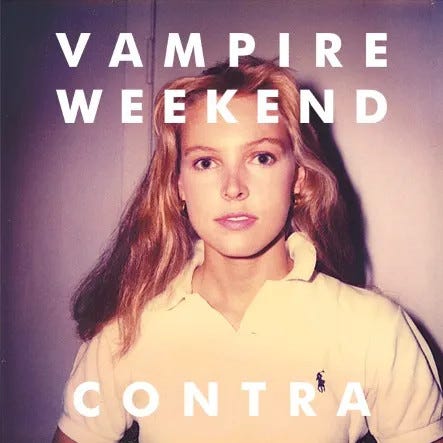
Then Contra came around, and Vampire Weekend had a chance to improve even more on the things they lacked. The band gains a bit more knowledge in this album. They no longer come to us as the naïve college students of a few years prior. This new album introduces an air of mystery to it, with the introduction of Vampire Weekend’s now notorious use of cryptic wordplay and twisting, winding imagery. There is also more usage of cultural sociological references which create a certain sense of classiness and sophistication to their lyrics. The music has grown up, too. Although the sounds of the self-titled album are unique from most other songs in their genre, they aren’t necessarily terribly unique amongst each other. However, in Contra we find something very different. Each song is vastly different from the other, with no two songs on the album sounding alike. That isn’t to say they lack album cohesion, nor do they stray away from the theme of the album. But each song stands alone, telling its own story. To understand this idea better, let’s deep-dive into the album a bit and explore Contra on a track-by-track basis.
Horchata, White Sky, Holiday, California English:
We begin our journey into the album with these four tracks, which embody the campiness of self-titled. They are quick, upbeat, energetic, and generally happy, with “White Sky” being the oddball of the family. Although it shares all those attributes with the other three, it also has the added bonus of odd meter and even stranger synth work. It has a bizarre sort of sound to it, broken up by even odder noises coming from Ezra in between verses as he yelps to the beat of the music. The four songs also have a generalized theme across them that attempts to invoke the imagery of winter, of togetherness in the cold, and the cozy feelings that can come with the cooler temperatures. “Horchata,” I believe, is one of the best opening tracks that Vampire Weekend created. It is a great bridge between what we’re familiar with, what we’ve seen in self-titled, and what is yet to come with this album.
Taxi Cab and Run:
“Taxi Cab” breaks up the wintery, cheerful theme and it does so in a very sudden, yet beautiful way. I appreciate the placement of all songs in the album but none more than the placement of “Taxi Cab.” It just belongs there. It introduces a slower, more melodic side to Vampire Weekend that we haven’t seen much before, and it does so in the midst of their usual energetic and upbeat style. Often times there are bands out there who will flip-flop the feelings they’d like to express, going from bubbly tale of romance to downbeat, disheartened songs of woe. In Vampire Weekend’s case, they have great cohesion because no two songs change pace so dramatically. “Taxi Cab” has that sound that just feels good. There’s a sense of yearning and a desire for more that can be heard in the music, a desire that I think is met very nicely in “Run.” “Run’s” backward-sounding guitar riff is backed by a very oddly syncopated beat, a sound that shouldn’t be too surprising to any Vampire Weekend fan at this point. Nonetheless, it is still something very different from previous works. It invokes imagery of the very young, burning desire to start a new chapter in one’s life. The need to start a new life, or to actually begin a new chapter can be exhilarating and bouncy, a sound that is captured quite nicely in this track.
Cousins:
What can I say about “Cousins?” It’s just a fun song. It’s energetic to the point of being frenetic. Fast guitars that would make Kirk Hammond of Metallica blush, speedy, crashing drums, and wild vocals from Ezra make this a song to remember. Let’s not forget the chiming bells during the outro, either. It’s just fantastic. As far as lyrics are concerned, as big of a fan of them as I am, as often as I have heard this song, I still really have no idea what it’s about, and that’s okay! It doesn’t detract from the song at all for me. “Cousins” grabs you by the face and makes you want to bounce around like an idiot in your dorm room at two in the morning.
Giving Up the Gun, Diplomat’s Son, and I Think Ur a Contra:
These three songs are without a doubt the most interesting and diverse on the album. They’re also the most mature, both in sound and in lyrical content. “Giving Up the Gun” tells the story of a soldier, or a fighter, metaphorical or literal doesn’t matter, who longs for the days when they were deep in the fight that brought them some sort of glory or reward. “Diplomat’s Son” is a convoluted tale about political corruption and the malaise that surrounds it, while “I Think Ur a Contra” stands out to me as a song about someone who has changed, someone who used to be a good match for the narrator, but is revealed to be a liar and a cheat now. The topics on all three of these songs are very complex and tell a genuine story, something lacking in the first album for the vast majority of it. “Giving Up the Gun” is a song where Chris Baio’s performance as a bassist really shines. Though the song is of course a team effort. The small chimes from what I assume is a xylophone, the drumline, Ezra’s soft-spoken words — they all make the song what it is. “Diplomat’s Son” is another one of those odd sounding songs, but it’s so unique and cool and interesting. It’s my favorite song off the album. I’m not alone in my fascination, love and appreciation. When I attended one of their concerts during their Father of the Bride tour, they asked someone to pick a song for them to play right there and then. They grabbed a couple of young women from the audience who, in the surge of excitement and screaming from the audience, seemed to have shouted “Diplomat’s Son.” Ezra repeated it into his microphone to confirm it and the entire stage roared. They spoke up clearer a second time, however, and it turns out that they wanted to hear “Giving Up the Gun.” When they cleared it up, there was a fair bit of jeering from the audience, so much so that Ezra Koenig spoke up and said something to the effect of, “it’s their song. You have to let them choose.” It’s not that the aforementioned track is so terrible — it isn’t. It’s that “Diplomat’s Son” is such a unique and gripping song. It’s chill, but it’s a little aggressive, too. It builds up tension but doesn’t drop it like a dubstep song. It lets you sit with it, instead. It’s really a great song. And then, of course, we have the closing track on the album, and who couldn’t love the idyllic sounds of “I Think Ur A Contra?” There’s a level of tenderness in the melody, and the synth work creates an atmospheric landscape that is soft and melancholic. Of course, the revival of the afro-pop drumline makes everything even more visceral and almost acoustic in quality.
The Final Word

In sum, Vampire Weekend’s Contra highlights a vast amount of growth that must have happened in just a few short years for this band. Although self-titled is a fantastic album, and should be praised for its unique and experimental combination of sounds, it is trumped by Contra’s ability to have all of those attributes, and still be more articulate, have a more refined sound, and be able to tell some very interesting and thought-provoking stories. Many would claim that Contra is the best Vampire Weekend album of all time. It does have a very strong following amongst Vampire Weekend fans. I don’t agree, but it comes in a very, very close second for me. It will forever stand out, in my mind, as the album where the band really found its sound and began to fill into themselves.
 Den Elliot
Leave a comment